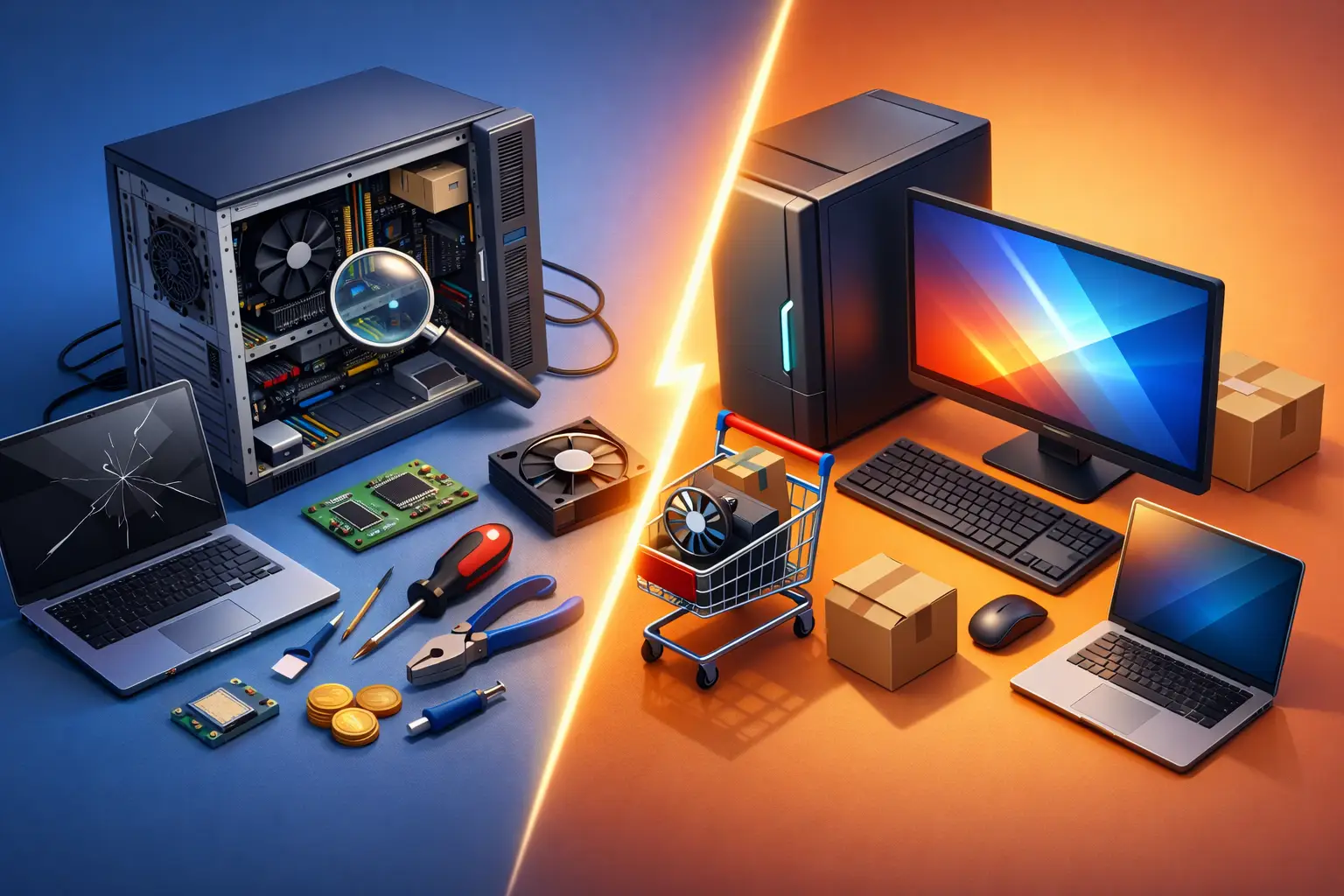
A computer that will not start, keeps crashing, or has become painfully slow can make replacement feel like the only answer. But the PC repair cost versus replacement decision is rarely that simple. A focused repair can restore years of useful life for far less than a new machine, while sinking money into an aging computer with major hardware limitations may only delay the inevitable.
The right choice comes down to the actual fault, the computer’s age and specifications, what you use it for, and how much downtime is costing you. A clear diagnosis should come before a purchase decision.
Start With the Problem, Not the Age
A five-year-old computer is not automatically ready for retirement. Many PCs from the last several years can still handle web browsing, office applications, schoolwork, video calls, accounting software, and everyday business tasks very well after the right repair or upgrade.
For example, a computer that takes ten minutes to boot may have a failing hard drive, too little memory, unwanted software, or a Windows issue. Replacing an old spinning hard drive with a solid-state drive can make a dramatic difference. Adding RAM may solve slowdowns caused by too many browser tabs or demanding applications. These are usually targeted repairs, not reasons to discard the entire system.
On the other hand, a computer with a failed motherboard, repeated overheating, obsolete processor support, and an aging power supply may be approaching a point where replacement makes more financial sense. The key is separating one fixable issue from several expensive problems happening at once.
PC Repair Cost Versus Replacement: The Cost Test
A useful rule of thumb is to compare the repair estimate against the cost of a replacement that truly meets your needs. If a repair is a small fraction of the price of a comparable new PC and the system has no other major weaknesses, repair is often the sensible option.
The comparison is not always just repair cost versus the sticker price of a new computer. A replacement may also involve data transfer, software installation, printer setup, email configuration, security settings, and time spent getting everything back to normal. For a home user, that is frustrating. For a small business, it can mean lost work hours and interrupted service.
A repair estimate should explain what failed, what parts or labor are involved, and whether another issue is likely to surface soon. Free diagnostics are especially valuable here because they allow you to make the decision with facts instead of guessing based on a symptom.
At Don’t Panic! Computer Repair, transparent hourly billing at $80 per hour helps customers understand the labor side of a repair before moving forward. A straightforward issue may be much more affordable than replacing a computer that otherwise still fits the job.
When Repair Usually Makes Sense
Repair is commonly the better value when the computer is relatively modern and has a specific, isolated fault. A damaged charging port, failed battery, broken laptop screen, bad hard drive, malware infection, or software issue can often be fixed without changing the entire device.
It also makes sense when the computer has enough performance for your normal workload. If you use a desktop for email, bookkeeping, online classes, documents, and video calls, you may not need the latest processor. A storage or memory upgrade can be a practical way to improve speed without paying for features you will never use.
Repair may be especially worthwhile when your current setup includes specialized software, custom peripherals, or a business workflow that would take time to rebuild. Keeping a familiar workstation running can prevent unnecessary disruption, as long as it remains secure and dependable.
For custom desktop PCs, repair is often more flexible than replacement. Individual components can be tested and replaced. A failed graphics card, power supply, cooling component, or drive does not necessarily mean the processor, case, memory, and motherboard have lost their value.
When Replacement Is the Better Investment
Replacement deserves serious consideration when the PC cannot support the software, security, or speed your work requires. Older computers may be unable to run a supported operating system, struggle with modern applications, or lack the memory and processor power needed for reliable multitasking.
Repeated repairs are another warning sign. One repair is normal. Several unrelated failures over a short period can indicate that the system is wearing out. If you have already replaced the drive, upgraded memory, and dealt with power or cooling issues, putting more money into the same machine may not be the best long-term choice.
Replacement can also be the right call when your needs have changed. A remote worker who now handles large spreadsheets, video meetings, multiple monitors, or design software may have outgrown a basic laptop. A small business adding staff, shared files, workstations, or new security requirements may need an IT plan rather than another one-off computer repair.
Laptop damage requires a more careful calculation. Screen, keyboard, battery, and storage repairs can be worthwhile. But major liquid damage, motherboard failure, or damage to multiple components can quickly make replacement more practical, particularly on an older budget laptop.
Do Not Forget Data, Setup, and Downtime
The least expensive hardware decision is not always the least expensive overall decision. Before replacing a computer, consider whether important documents, photos, passwords, browser bookmarks, email files, or business data are stored only on the old device. A dead hard drive can make data recovery more complicated and costly if no backup exists.
If the computer still turns on, back up important files before it gets worse. If it does not, avoid repeated restart attempts, unusual do-it-yourself fixes, or opening the device unless you know what you are doing. Those steps can sometimes complicate recovery or cause additional damage.
For business owners, downtime deserves its own line in the budget. A workstation that keeps failing can affect employee productivity, customer communication, invoicing, access to files, and security. In that situation, a fast replacement may be justified even when repair is technically possible. A temporary repair or data migration plan can also keep work moving while a new system is prepared.
A Better Way to Decide Before You Buy
Rather than choosing based on frustration, ask for an assessment that answers a few practical questions: What exactly failed? Is the repair likely to solve the problem for the long term? Does the PC still meet your performance and security needs? What will replacement require beyond buying the hardware?
A technician should be able to explain the answer in plain language. You do not need to know motherboard specifications or Windows error codes to make a good decision. You need a realistic estimate, an honest view of the computer’s remaining life, and a plan for protecting your files.
If replacement is recommended, make sure the new computer is selected for your actual work. Paying for a powerful gaming-style system for basic office tasks is unnecessary. Buying the cheapest option for a demanding workstation can create the same problem again too soon. The best replacement is one that fits your software, workload, storage needs, and expected life span.
Get a Clear Answer Before Spending More
There is no prize for keeping an old PC alive forever, and there is no reason to replace a computer that needs one sensible fix. The right decision should leave you with dependable technology, protected data, and a cost you understand. A quick diagnosis can turn a stressful computer problem into a clear next step – whether that means repairing what you have or moving forward with a system that is ready for the work ahead.


One thought on “PC Repair Cost Versus Replacement: Which Is Better?”