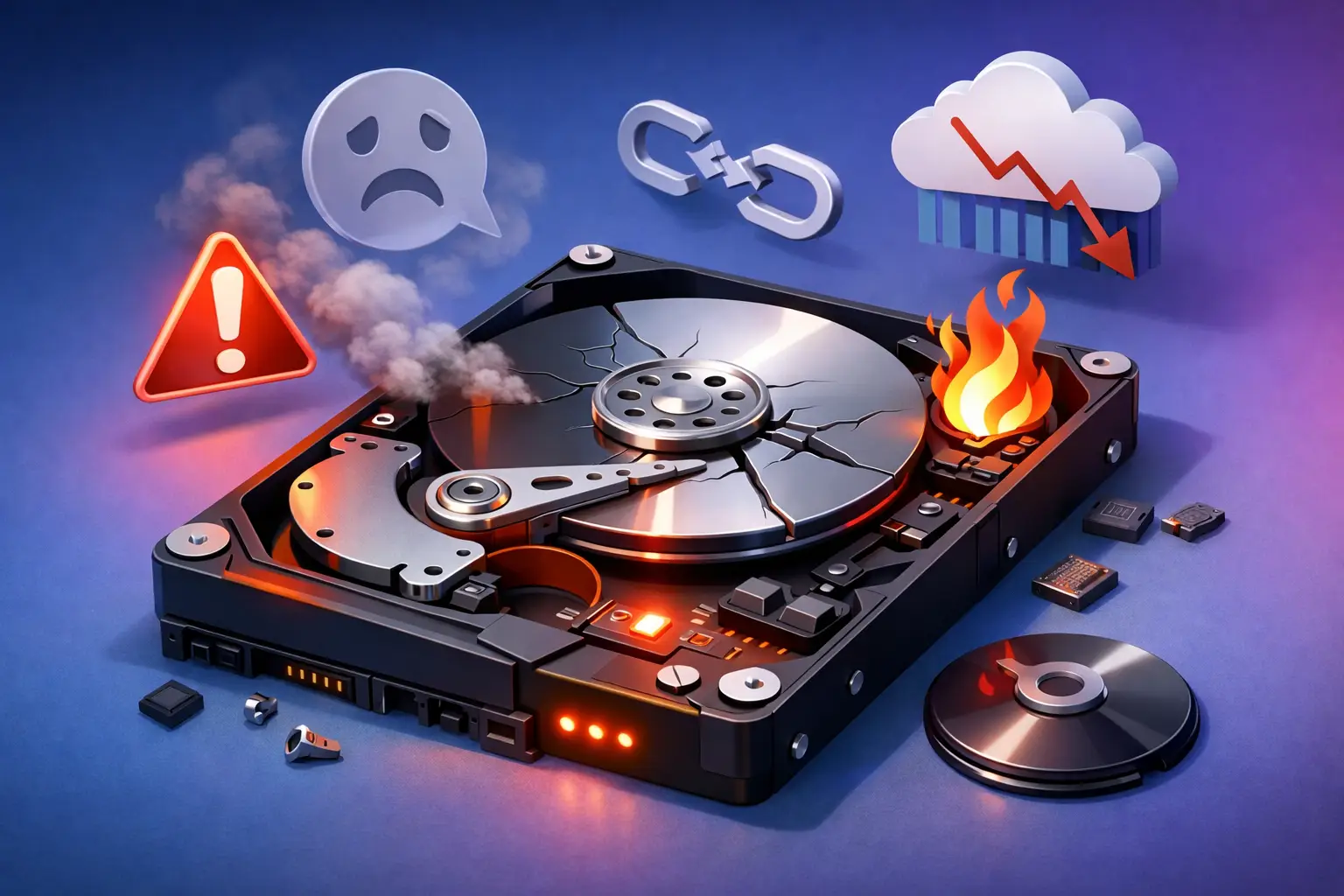
A computer that suddenly takes 10 minutes to open a folder, freezes while you are saving a document, or makes a new clicking sound is not just being annoying. Those can be top signs of hard drive failure. The right move is usually not to keep restarting it and hoping the problem clears up. If your files matter, protect them first and troubleshoot second.
Hard drives can fail gradually, giving you time to copy data and replace the drive. They can also fail without much warning, especially after a drop, power event, or long period of overheating. Knowing the difference between a minor slowdown and a storage problem can save a homeowner’s photos, a student’s coursework, or a small business’s working files.
Top Signs of Hard Drive Failure
Clicking, grinding, or repeated beeping
A healthy traditional hard drive makes a low, steady whir when it is working. Repeated clicking, grinding, scraping, or a rhythmic beep is different. On a mechanical hard drive, those sounds may mean the read/write heads or internal motor cannot access data correctly.
Turn the computer off if the sound is loud, new, or repeats every time you power it on. Do not keep rebooting it to see whether it improves. Each attempt can put more stress on a drive that is already struggling. Solid-state drives do not have moving parts, so they normally do not make drive-related clicking sounds. If a laptop with an SSD clicks, the sound may be coming from a fan or another component, but it still deserves a proper check.
Files disappear, will not open, or become corrupted
A document that vanishes from a familiar folder, a photo that will not load, or a file that opens with errors can point to damaged sectors on a hard drive. You might also see files with strange names, folders that appear empty, or messages saying a file is unreadable.
One damaged file does not automatically mean the drive is failing. A bad download, a software crash, or a sync issue can cause a single problem. When file errors keep happening in different locations, however, take it seriously. Copy the most valuable data to a separate external drive or secure cloud storage as soon as possible.
The computer freezes during simple tasks
An older computer can feel slow because it needs more memory, has too many startup programs, or is running an outdated operating system. Hard drive trouble has a different pattern. The computer may stop responding when you open File Explorer, search for a file, launch a program, or save a spreadsheet. The mouse might still move while the system waits unusually long for the drive.
Pay attention to whether freezes happen during tasks that access stored files. If the same application crashes at random, software could be the issue. If many unrelated programs hang while the drive light stays active, the storage device becomes a more likely cause.
Frequent error messages at startup
Messages such as “No boot device found,” “Operating system not found,” or automatic repair screens can mean the computer cannot reliably read the drive where Windows or macOS is installed. A system that starts normally one day, then fails to find its operating system the next, should be checked quickly.
A loose cable can cause a similar error on a desktop computer, and a failed update can sometimes damage startup files. That is why an accurate diagnosis matters. The error does not always mean the drive itself is beyond recovery, but it does mean you should avoid writing new data to it until the cause is known.
Blue screens, crashes, and unexpected restarts
Blue screens on Windows and repeated crashes on any computer have many possible causes, including bad memory, overheating, driver conflicts, and malware. But when crashes are paired with slow file access, corrupted files, or boot errors, a failing hard drive belongs high on the list of suspects.
Watch for timing. Does the system restart when you copy a large folder, install an update, or open a project stored on the drive? That connection can help separate a storage issue from a general software problem.
Disk warnings from the operating system
Windows may display a warning that it detected a hard disk problem, ask to scan and repair a drive, or report errors when running a disk check. A Mac may flag a disk in its storage utilities. Do not dismiss these alerts just because the computer still works afterward.
Some repair tools can fix file system errors, which are problems with how data is organized. They cannot repair physical wear inside a mechanical drive. Running repeated scans on a severely failing drive can also take a long time and add strain. Back up first whenever you can, then get advice on the safest next step.
Dramatically slower startup and transfers
A drive that once started your computer in a minute but now takes several minutes may be nearing failure, particularly if the slowdown appeared suddenly. Long delays copying files, opening photos, or loading basic programs are another warning. The drive may be repeatedly trying to read weak or damaged areas before it gives up.
This symptom depends on the computer. A conventional hard drive will always be slower than an SSD, and an older machine may simply have limited performance. What matters most is a noticeable change from that computer’s normal behavior.
What to Do When You Suspect a Failing Drive
Your first priority is data, not repairs. Avoid installing new programs, downloading large files, or moving files around unnecessarily. Every write to a failing drive can overwrite data that may still be recoverable.
If the computer starts and remains stable long enough, focus on the irreplaceable items first:
- Family photos, videos, and scanned records
- Business documents, accounting files, and customer data
- Schoolwork, creative projects, and local email archives
- Browser bookmarks, passwords, and any files not already synced elsewhere
Copy them to a separate drive or a trusted cloud account. Do not back up to another folder on the same computer. That does not protect you if the drive stops working completely.
If the computer will not boot, makes repeated mechanical noises, or disconnects while you are copying files, stop trying random fixes. Do not open the drive casing. Mechanical drives are sealed devices, and opening one outside a controlled recovery environment can make data recovery much harder.
Can a Failing Hard Drive Be Repaired?
Sometimes the issue is logical rather than physical. A corrupted file system, damaged startup configuration, or bad cable may be repairable without replacing the drive. If a drive has failing internal components or growing bad sectors, replacement is usually the reliable answer.
For most home and small business computers, moving to a quality SSD is a practical upgrade. SSDs are much faster than traditional hard drives and have no spinning platters or moving heads. They can still fail, so backups remain necessary, but they are less vulnerable to shock and mechanical wear.
Whether data can be recovered depends on the failure type, how much the drive has been used since problems started, and whether the information was overwritten. A drive that is readable but unstable may allow a technician to transfer data to a new device. A drive with severe physical damage may require specialized recovery services, which can be costly and cannot be guaranteed.
When to Call for Help
Call for help promptly when you hear clicking or grinding, see repeated boot errors, or cannot access important files. Small business owners should treat unusual drive behavior as an operational issue, not an inconvenience. One failing workstation can interrupt billing, scheduling, customer communication, and access to shared documents.
For Salt Lake City customers, Don’t Panic! Computer Repair can diagnose a computer on-site or remotely when appropriate, explain whether the problem appears to be the drive or something else, and provide a clear path forward. The goal is to protect what can be protected and get your computer working again without adding confusion to an already stressful problem.
A failing drive does not always mean your files are gone. The earlier you stop using it heavily and make a careful plan, the better your chances of avoiding a much bigger loss.