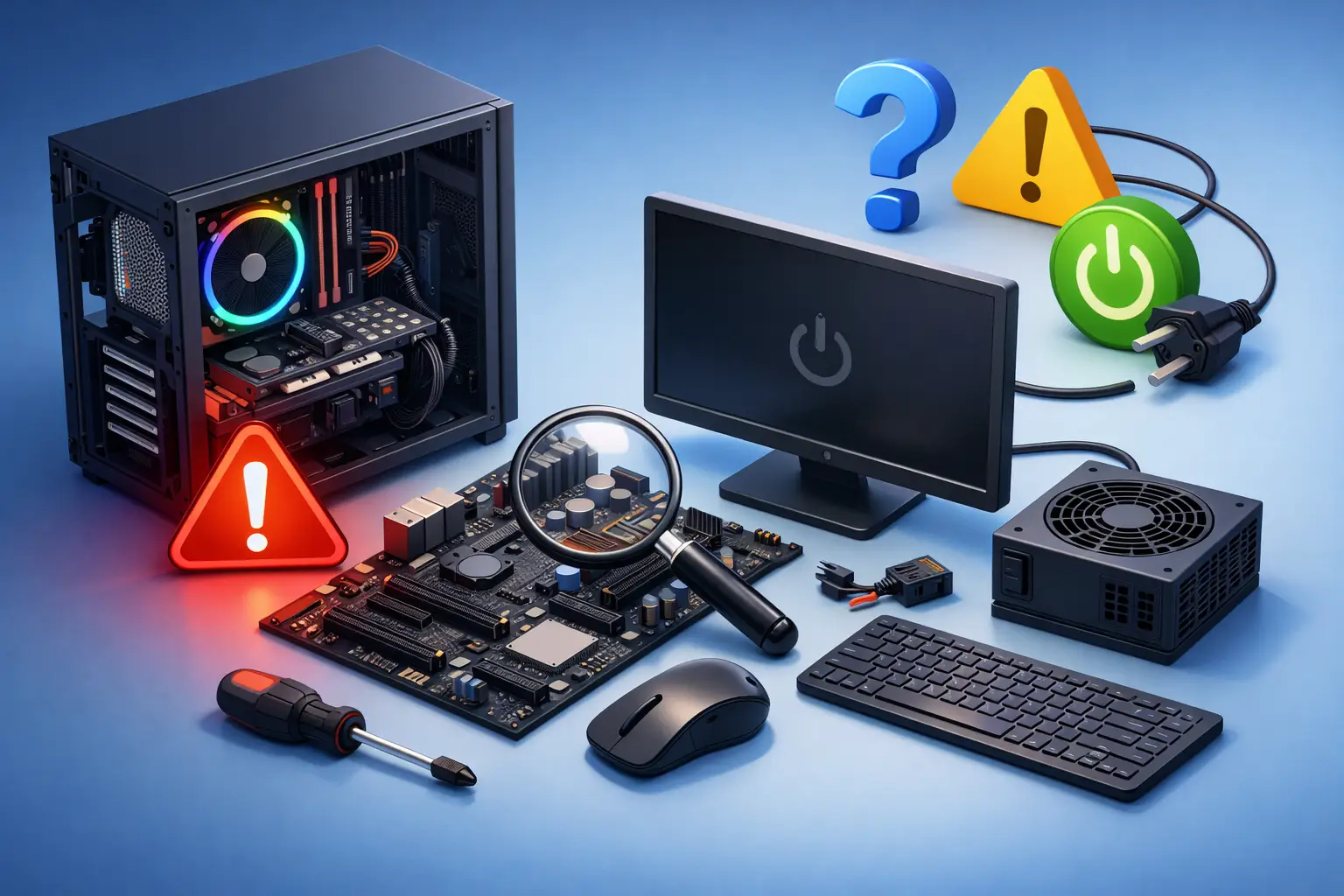
A PC that will not boot can stop a workday, interrupt school, or leave a small business without access to critical files. If you are searching “why wont my pc boot,” the first step is to identify what the computer is actually doing. A black screen, no power at all, a spinning logo, and a Windows error can look similar from across the room, but they point to very different fixes.
Do not keep forcing restarts without checking the basics. A few calm observations can help you avoid lost data, unnecessary parts purchases, and extra downtime.
Why Won’t My PC Boot? Identify the Symptom First
“Won’t boot” can mean several things. Before changing settings or opening the computer, look for the point where the startup process stops.
If there are no lights, no fans, and no sound, the issue is likely related to power. If the PC lights up and fans run but the monitor stays blank, the computer may be running without producing a usable display signal. If you see the manufacturer logo or Windows logo and then it freezes, restarts, or shows an error, the problem is more likely with Windows, a storage drive, or a connected device.
This distinction matters. Reinstalling Windows will not fix a disconnected monitor cable, and replacing a power supply will not fix a corrupted Windows update.
Start With the Safe, Simple Checks
Begin with the items that are easy to verify and unlikely to cause harm. Shut the PC down fully first. If it is frozen, hold the power button for about 10 seconds, then wait another 30 seconds before trying again.
Check these four things:
- Confirm the wall outlet, surge protector, and power cable are firmly connected. Plug a lamp or phone charger into the same outlet if you are unsure whether it has power.
- If it is a desktop, check that the power supply switch on the back is set to the “I” position, not “O.”
- For a laptop, connect the charger directly to a known-working wall outlet. Look for a charging light, but remember that some failed chargers and batteries will not show one.
- Disconnect nonessential USB devices, including external drives, printers, webcams, docks, game controllers, and flash drives.
A USB drive can sometimes make a PC attempt to boot from the wrong device. A failing external drive can also delay or interrupt startup. Leave only the keyboard, mouse, monitor, and power connected to a desktop while testing.
If you use a laptop with a docking station, remove the dock and connect the charger directly to the laptop. Docks are useful, but they add another possible point of failure.
When the PC Has Power but the Screen Is Black
A powered-on computer with a black screen is one of the most common and confusing problems. Look closely at the monitor first. Is its power light on? Does it say “No Signal”? If so, the monitor is working but is not receiving video from the computer.
Make sure the monitor is set to the correct input, such as HDMI or DisplayPort. Then reseat the video cable at both ends. If possible, test with another cable or another monitor. HDMI cables in particular can fail without obvious visible damage.
On many desktop PCs, the monitor cable must connect to the graphics card lower on the back of the tower, rather than the video ports near the USB ports. This is especially common on gaming PCs and workstation builds with a dedicated graphics card. Connecting the screen to the wrong port can produce a blank display even though the PC is otherwise functioning.
For laptops, raise the screen brightness and try connecting an external monitor or TV. If the external display works, the issue may be the laptop screen, display cable, or backlight rather than the entire computer.
You can also try a power reset. Turn the PC off, unplug it, and for a laptop remove the battery only if it is designed to be removable. Hold the power button for 15 to 20 seconds, reconnect power, and start it again. This drains residual charge and can resolve a temporary hardware state issue.
If Windows Starts but Will Not Finish Loading
When you see the Windows logo, spinning dots, an automatic repair screen, or a blue error screen, power and video are probably not the main issue. Windows may be struggling with an update, damaged system files, a driver problem, or a failing storage drive.
First, give the computer a little time. A large update can make a PC appear stuck, especially on an older hard drive. If the spinning dots continue changing and the drive activity light is active, waiting 20 to 30 minutes may be reasonable. If nothing changes for a long time, restart the computer once and see whether Windows enters recovery mode.
From the recovery screen, use Startup Repair before attempting more disruptive options. Startup Repair can correct certain boot configuration problems without removing personal files. If Windows recently updated or a new driver caused the trouble, System Restore may return the computer to an earlier working state. It is generally less disruptive than resetting or reinstalling Windows.
Avoid choosing “Reset this PC” unless you understand the options and have a backup. Even the option intended to keep personal files can remove installed programs, change settings, and create more work afterward. A full reinstall may be appropriate in some situations, but it should not be the first move when important files are still on the machine.
Hardware Warning Signs You Should Take Seriously
Some boot failures are clear signs that a part needs professional attention. Repeated clicking from a traditional hard drive, a burning smell, a pop, visible liquid damage, or a PC that turns on and immediately shuts off are reasons to stop testing. Continuing to power on a failing drive can reduce the chance of recovering data. Continuing to run a system with electrical damage can harm additional components.
Be cautious with error messages such as “No boot device found,” “SMART status bad,” or “Boot device not detected.” These messages may mean the SSD or hard drive is loose, has failed, or is not being recognized. On an older desktop, a cable or drive replacement may be straightforward. On a laptop or a business workstation with encryption, RAID storage, or critical files, the situation can be more complicated.
A PC that powers on for a second and shuts off may have a power supply, motherboard, RAM, or overheating issue. Do not open a power supply unit. It contains components that can retain dangerous electrical charge even after it has been unplugged.
What You Can Check Inside a Desktop PC
If you are comfortable working around computer components, disconnect power and touch an unpainted metal part of the case before touching internal hardware. Check whether RAM modules, graphics cards, and drive cables are fully seated. A desktop moved during cleaning, relocation, or shipping can develop a loose connection.
Test one change at a time. For example, reseat the RAM, then try booting again. Do not remove several parts at once and hope for the best, because it becomes difficult to know what changed. If your PC begins beeping or showing diagnostic lights, write down the pattern or take a photo. Those details can speed up diagnosis.
For most people, this is a sensible stopping point. Internal troubleshooting can be useful, but it also carries risk if the device is still under warranty, uses proprietary components, or contains data you cannot afford to lose.
When to Call for PC Boot Repair
Call for help when basic checks do not restore a display, Windows repeatedly fails to load, you suspect a drive is failing, or the PC contains files your household or business needs right away. Small business systems deserve particular caution. A workstation that will not boot may be tied to shared files, accounting software, email access, network drives, or a server environment.
A technician can test power delivery, display output, memory, storage health, Windows recovery options, and hardware connections without guessing at the problem. For Salt Lake City customers, Don’t Panic! Computer Repair can come to your home or business, provide diagnostics, explain the repair options clearly, and help get the system back into service without the usual trip to a repair shop.
The best next step is the one that protects your data and limits downtime. If the easy checks do not reveal the issue, stop cycling the power, keep the computer connected as it is, and get a clear diagnosis before making a major change.