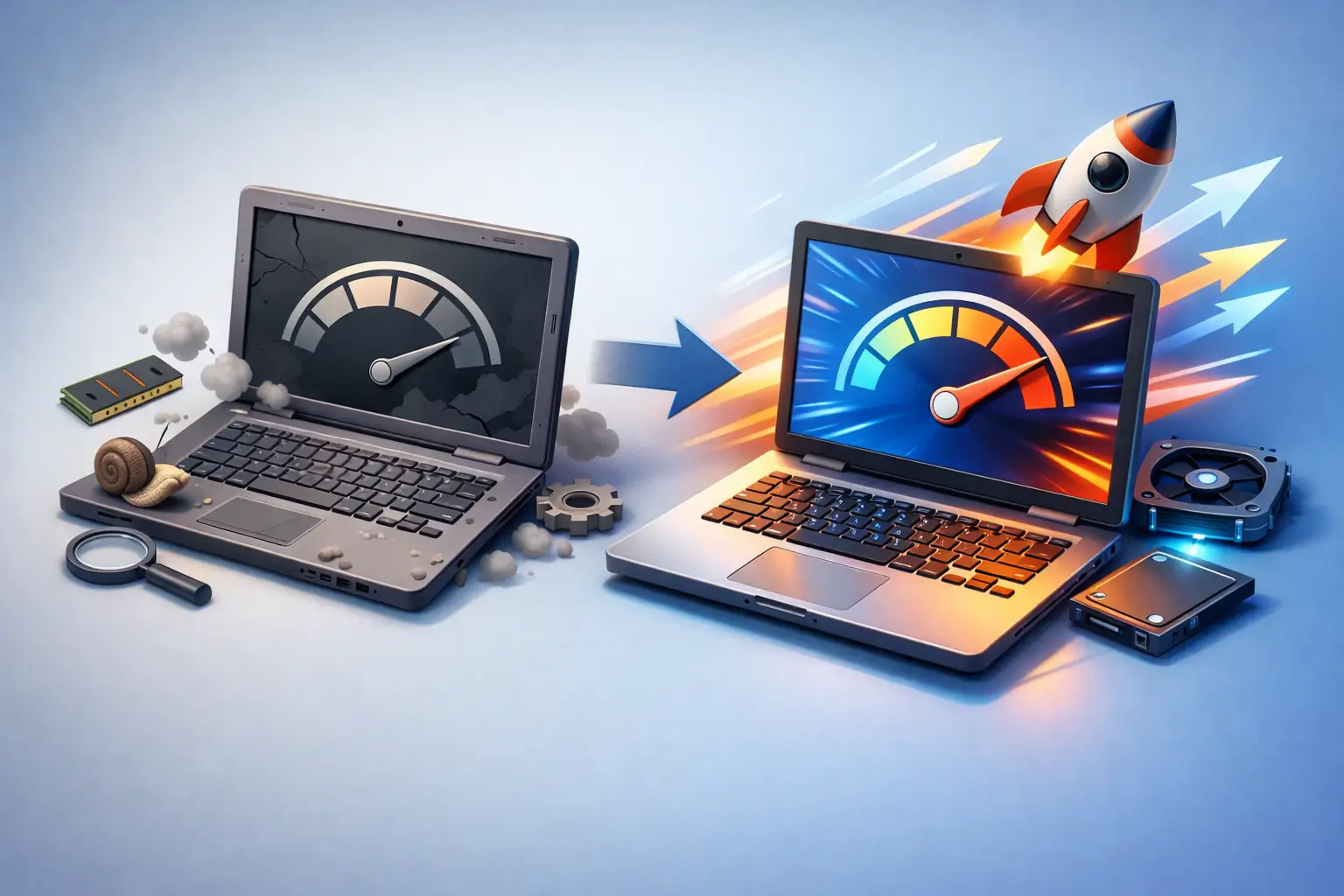
When your laptop takes longer to open a browser than it does to make coffee, it is not always a sign that the machine is finished. If you are searching for how to speed up old laptop performance, the good news is that many slowdowns come from a handful of very fixable problems – overloaded startup programs, low storage, aging hard drives, overheating, or too little memory for the way you work now.
The trick is not trying everything at once. A slow laptop usually has one or two main bottlenecks, and if you fix those first, you can often get a very noticeable improvement without replacing the computer.
How to speed up old laptop without wasting time
Start with the simplest question: when is it slow? Some laptops are sluggish all the time. Others only drag at startup, when too many tabs are open, or during video calls. That pattern matters because it points to the cause.
If the laptop is mostly slow when turning on, startup apps are a likely problem. If it freezes when switching between programs, you may be running short on RAM. If everything takes forever to open, especially on an older machine, the storage drive may be the real issue. If it gets hot and then slows down, heat buildup can force the system to throttle itself.
That is why quick fixes should come before expensive ones. A little cleanup might be enough. On the other hand, if you are still using an old mechanical hard drive, no amount of tidying will feel as dramatic as replacing it with a solid-state drive.
Cut back startup programs
One of the easiest ways to improve an aging laptop is to stop unnecessary software from launching every time Windows starts. A lot of programs install themselves into startup without asking clearly, and over time that adds up.
Look through your startup list and disable anything you do not need immediately after booting. Chat apps, game launchers, cloud sync tools you rarely use, printer utilities, and software updaters are common offenders. Be careful not to disable security software or hardware drivers, but many extras can safely wait until you actually open them.
This will not fix every type of lag, but it can make the laptop feel less bogged down right from the start.
Free up storage space
A laptop that is nearly full usually runs worse. Windows needs working room for updates, temporary files, browser cache, and virtual memory. When the drive is packed to the brim, performance often drops and updates may fail.
Delete files you no longer need, uninstall software you never use, and empty the recycle bin. Large downloads, duplicate photos, old videos, and forgotten installers tend to pile up quietly. If you are down to just a few gigabytes free, reclaiming space can help more than people expect.
That said, storage cleanup has limits. If your laptop has an old hard drive and the system still feels painfully slow even with plenty of free space, the issue may be the drive speed itself, not just the amount of room left.
The biggest upgrade for many old laptops
If you want the single most effective answer to how to speed up old laptop performance, this is often it: replace a traditional hard drive with an SSD.
Older laptops commonly came with spinning hard drives. They work, but they are dramatically slower than modern solid-state drives. An SSD can reduce boot times, make programs open faster, and improve the whole feel of the system. It does not make an old processor new, but it removes one of the most common causes of that constant waiting.
For many users, this is the point where the laptop goes from frustrating to usable again. If you mainly browse, work in Office apps, attend classes, or handle email and business tasks, an SSD upgrade can extend the life of the machine quite a bit.
The trade-off is compatibility and labor. Some laptops are easy to upgrade. Others are more sealed up, and a few newer thin models have storage soldered or harder to access. If you are not comfortable opening the system, this is one of those jobs that is often worth having done correctly the first time.
Add more RAM if multitasking is the problem
RAM matters most when your laptop slows down under a workload, not just at startup. If opening several browser tabs, Zoom, spreadsheets, or accounting software makes the system crawl, you may simply not have enough memory.
A laptop with 4GB of RAM can feel very limited today. Moving to 8GB often helps basic everyday use a lot. For heavier multitasking, 16GB may be the better target if the laptop supports it.
Still, RAM upgrades are not magic. If the machine has a very old processor or a failing hard drive, adding memory may help only a little. This is where proper diagnosis saves time and money. The right upgrade depends on the actual bottleneck.
Fix overheating before it causes more lag
Heat can make a laptop feel slow even when the hardware is decent. Dust buildup in fans and vents reduces airflow, which raises temperatures. When the system gets too hot, it protects itself by lowering performance.
If the laptop sounds loud, feels hot on the bottom, or slows down after running for a while, overheating is worth checking. Cleaning out dust can help. So can making sure the laptop is used on a hard surface instead of a blanket or couch cushion that blocks airflow.
In some older systems, worn thermal paste between the processor and heatsink can also contribute to heat problems. That is a more advanced repair, but it can make a real difference when temperatures are consistently high.
Watch for malware and background clutter
Not every slow laptop has malware, but some do. Browser hijackers, fake cleanup tools, unwanted add-ons, and poorly behaved background processes can all eat up system resources.
Run a reputable security scan and review installed programs and browser extensions. If your homepage changes on its own, pop-ups are appearing, or the fan runs hard even when you are doing almost nothing, it is worth taking seriously.
Even without malware, years of software installs and removals can leave behind enough clutter to affect performance. Sometimes a proper cleanup works. Other times, a clean operating system reinstall is the faster path to a stable result.
When a reset or reinstall makes sense
If your laptop has had the same Windows installation for years, has lots of old software, and still runs poorly after basic cleanup, a reset or fresh reinstall can help. This strips away accumulated junk and gives the system a cleaner starting point.
The catch is preparation. Files need to be backed up first. Programs will need to be reinstalled. Email setup, printers, and business software may need to be configured again. For home users that can be manageable. For small businesses, it can be disruptive if handled casually.
A reinstall is most useful when the hardware is still good enough but the software environment has become messy. If the laptop has a failing drive, battery issues, or severe overheating, reinstalling alone will not solve the real problem.
Know when the laptop is just too old
Sometimes the honest answer is that the laptop can be improved, but not enough to meet your needs. If it cannot run current software well, no longer receives proper updates, or struggles with basic work even after an SSD and RAM upgrade, replacement may be the better investment.
This is especially true for business users and remote workers. Lost time costs more than people realize. If a machine wastes twenty minutes a day through freezes, long boot times, and failed updates, that adds up quickly.
Still, plenty of older laptops are worth saving. A five-to-eight-year-old system with upgradeable parts can often be made very usable again. A very old machine with a weak processor and limited upgrade options may only be good for light tasks.
A practical order to try fixes
If you want a clear path, start by removing unnecessary startup apps, freeing space, checking for malware, and installing pending updates. If the laptop remains slow, pay attention to symptoms. Constant slowness often points to storage. Slowdowns under multitasking suggest low RAM. Performance drops after heat builds up suggest cooling problems.
From there, decide whether an SSD upgrade, RAM upgrade, internal cleaning, or a fresh reinstall makes the most sense. If you are not sure, that is usually the point where a professional diagnosis pays off. It is better to spend money on the right fix than on parts that only help a little.
For people in Salt Lake City who want the problem handled without hauling a laptop to a shop, Don’t Panic! Computer Repair can come to you, figure out what is actually slowing the system down, and give you a clear repair path before the guessing gets expensive.
An old laptop does not need to feel fast by 2026 standards to be worth keeping. It just needs to be dependable enough that you stop thinking about it every five minutes.